Me? Feed a crowd?
One summer, long ago, I volunteered to help cook for our youth group at a week-long summer camp. Fortunately, the other cook had experience because those were the days I was only cooking for Hubby and myself at home.
To feed a crowd (of hungry teens) took meticulous planning, shopping, preparation and time. I wouldn’t dream of repeating this on my own!
Important to Feed
In Scripture, you can always tell when something is important because it is repeated. The more it is repeat3ed, the more important it is. So today, as we look at feeding the 5,000, we should note that this is the ONLY miracle mentioned in ALL FOUR Gospels:
- Matt. 14:13-21
- Mark 6:31-44
- Luke 9:10-17
- John 6:1-14
Plus, it is mentioned AGAIN in Matthew and Mark – so SIX mentions in all! If nothing else, it speaks to Christ’s awareness/compassion for our basic physical needs.
Who to Feed
Our focus today is primarily from John 6:1-14. For context, John the Baptist has been killed, and the 12 have just returned from their first mission trip. Everyone needed time and space to regroup and refresh. So Jesus led His men by boat to the far shore of the Sea of Galilee to Bethsaida (v.1).
But the retreat was short-lived. Verse 2 tells us a “great crowd of people followed Him because they saw the signs He had performed by healing the sick.” Matthew tells us a crowd met them on the shore (Mt 14:14.).
Even though He sought rest, He also saw their needs – both spiritual and physical. He knew any crowd was an opportunity for teaching, so (v 3) He went up on a mountainside and sat down with His disciples. In the Jewish culture, this signals learning time and not just rest. A rabbi sits with his students to teach/discuss.
How to Feed
As the crowd approaches, Jesus asks Philip where they will buy bread to feed all these people (v 5). Why Philip? It’s likely that Philip had been a follower of John the Baptist (John 1:35-43). With John’s death so recent, it’s possible that his former disciple was struggling. Perhaps Jesus engaged him specifically to ensure Philip remained focused rather than mired in his grief. Also, Philip is from this area!
Jesus wasn’t really asking for Philip’s advice. Verse 6 clearly says Christ knew what His plan was before He asked the question. Philip’s answer? “We don‘I have enough money to get bread for everyone to just have a bite.”
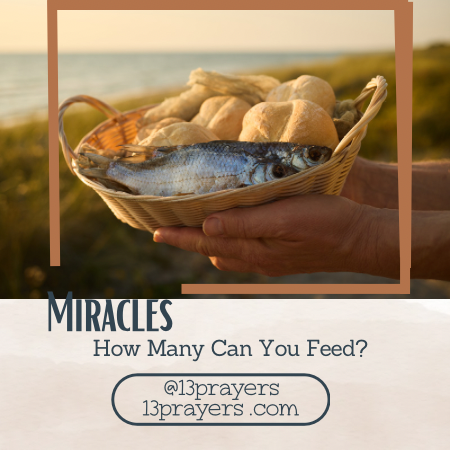
Then John’s other former disciple speaks up with critical information: (v 9) “Here is a boy with 5 small barley loaves and 2 small fish, but how far will they go among so many?”
Jesus didn’t answer that question. He just told them to have the people sit down. Then He took the food they had AND GAVE THANKS.
MINOR differences
All 4 Gospels agree on most of the story. One difference in John (v 11) where it says JESUS distributed the food. The others all say that He gave it to the 12 to distribute. Is this a big deal?
I don’t know, but in dealing with hungry crowds, I think His compassion would lead Him to feed in the most efficient way. This would also be more impactful on His disciples if they were participating in the miracle directly. But the food does come FROM JESUS – whether directly or through His men.
Feed until filled
Both verses 11 and 12 tell us the crowd ate all they wanted. They Jesus told His men to pick up the leftovers, and each of His disciples ended up with a full basket of bread.
The message in the numbers:
Remembering that the Jews assign significance to numbers, there is an additional layer in this story:
- 5 loaves- 5 represents the Torah – the 5 books of Moses. He wrote them, and they were key books in their history. They are our 1st 5 books of our Bible.
- 2 fish – the 2 tablets of the 10 commandments – yet another reference to Moses
- 12 baskets left over – the 12 tribes of Israel
So Jesus is demonstrating His power and authority over and beyond Moses and the Law. Unlike the religious leaders, Jesus taught a path to God that didn’t include perfection to the Law. And by BREAKING 5 & 2 and ending up with so much more, He shows His power surpasses even Moses.
He fed them until they were satisfied, and still had 12 baskets left over – meaning there is enough for ALL tribes.
- 5,000 men – Meaning it’s possible He fed 5,000 men + 5,000 women + 5,000 children OR MORE! But 5,000? Again 5 – refers to Moses and 1,000 refers to community. This showed He came to feed the ENTIRE Jewish community. So, in that case, having “Leftovers” would be for non-Jews! And 12 baskets may show the Gentile believers are grafted into the faith.
What this means for me:
- God can use what I bring- I may not see how my small gift can be used to feed thousands, but I need to give it anyway. God can take my raw material and transform it into more than I can imagine.
- Jesus still sees me in my grief – I’ve ;been absent here for quite a while as I grieved the loss of my mom. Somehow I never notice it was Philip and Andrew who are mentioned by name. It comforts me to see Jesus engaging with those in grief.
- Thanking God for little can multiply it – Every version of this story tells us Jesus stopped and gave thanks for what had been given. With Jesus as my example, I need to be more grateful for all I have and for what I ask God to give – even before it comes.
- Don’t be wasteful – Scripture doesn’t tell us what they did with all the leftovers, but since each disciple had a basket, it is reasonable to think they took them home. Regardless I am sure Jesus wouldn’t let any go to waste.
- My 5 loaves and 2 fish – My 5 & 2 are right here: this blog and my courses. And I get to share them with you! Thank you for reading and sharing.
I’m grateful for your patience with me and your continued presence here. Drop me a line and tell me about YOUR 5 & 2!




 by
by 
Leave a Reply